A documented political memoir

The cause is just.
The price is paid.Why do our people still suffer?

Half a Knife is a documented political memoir from inside the Amhara resistance — part testimony, part reckoning, and part warning to the coming generation. Written from memory and a long archive of posts, essays, letters, and broadcasts, it examines not only what the author witnessed, but what he misunderstood, what resistance cost, and why immense sacrifice and real gains still left the movement’s ultimate aims unfulfilled.

An honest reckoning. A wiser strategy.

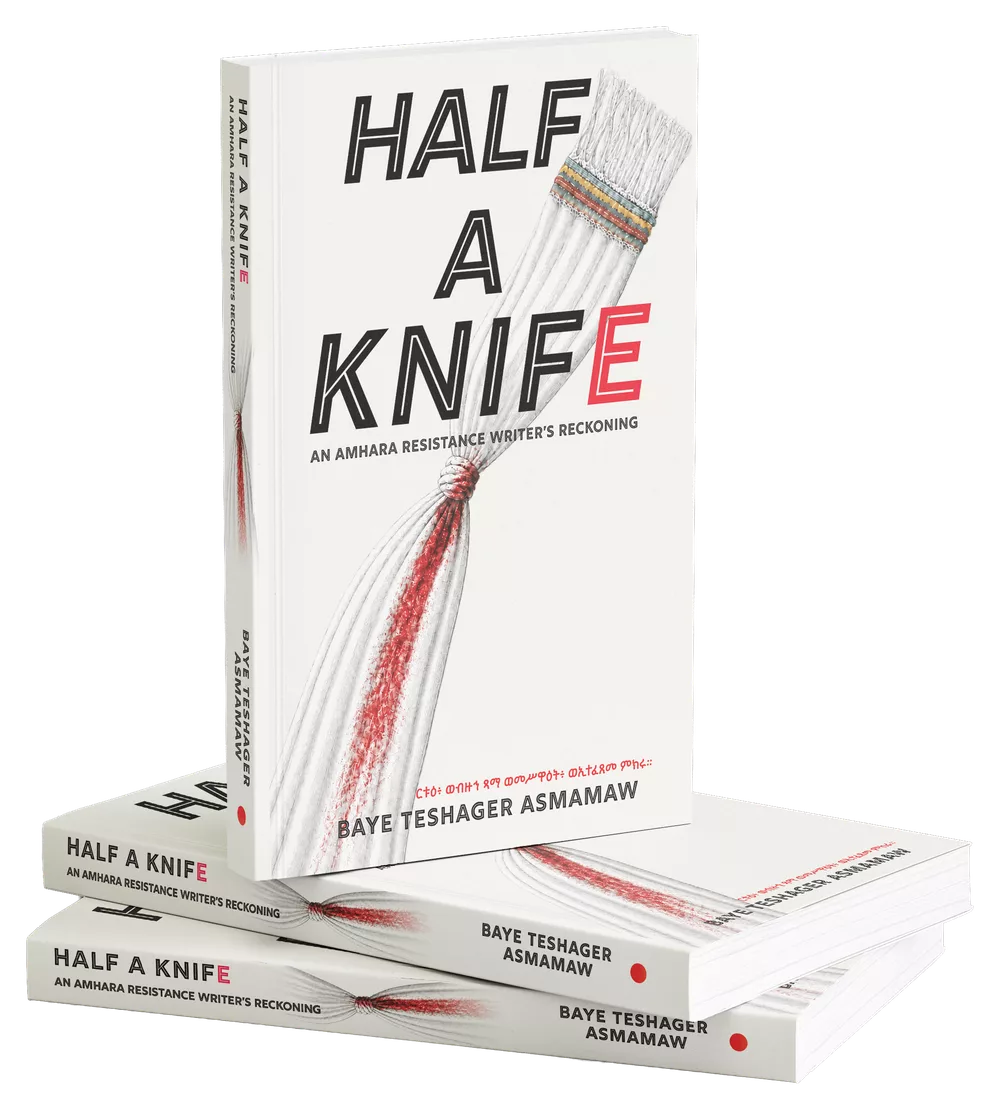
Three copies of Half a Knife: An Amhara Resistance Writer’s Reckoning by Baye Teshager Asmamaw — one standing upright on two lying flat. The cover sets the title in tall outlined capitals on warm white, the final letter in red, beside a ceremonial fly-whisk whose strands are stained red down the middle.

Right ርቱዕ

What the movement saw correctly about the danger to a people, and about a people’s right to defend its own life.

Costly ወብዙኅ ጻማ ወመሥዋዕት

What the struggle took. The dead first — and after them the living: careers, friendships, families, a country its people could not go back to.

Unfulfilled ወኢተፈጸመ ምክሩ

Why a correct reading of the danger, and sacrifice on that scale, still did not move the thing the movement existed to move.

ርቱዕ፥ ወብዙኅ ጻማ ወመሥዋዕት፥ ወኢተፈጸመ ምክሩ።right, and costly, and unfulfilled. The line on the cover. A knife that will not cut is half a knife.

What you are reading

The book does not ask you to approve of the author or condemn his opponents. It asks what conviction cost, where strategy failed, and what the next generation should do differently.

Testimony

A first-hand account of what one writer saw, wrote, argued, and broadcast across two continents — dated, sourced, and checkable.

Reckoning

Of the lines he drew in his own head and failed to draw on the page; of the rooms he walked out of that he should have stayed in.

Apology

For the harm done with the best of intentions, which sits in these pages beside the rest rather than being edited out of them.

Field manual

From inside a struggle whose sacrifice did not move the thing it existed to move — a record of what proclaiming costs, written by the one who paid, for whoever comes next and is tempted to pay it too.

What it is — and is not

It is

  • Written from memory and a long, dated archive of the author’s own words.
  • Willing to name what the movement understood correctly, and to say so plainly.
  • Written in English on purpose, to carry the account past the walls of its own chamber.
  • Addressed to the honest reader — including the reader who disagrees.

It is not

  • A score-settling book, or a case for any faction.
  • A demand that you agree before you are allowed to read it.
  • A clean version of the author’s own record.
  • A mobilisation text. Buying it proves no loyalty to anything.
No side is spared. Least of all my own.
Method

Archive before memory

Memory flatters the person doing the remembering. The book was built against that: every claim about what the author believed at the time was checked against what he actually wrote at the time.

Where memory and the archive disagreed, the archive won.

The archive runs to 3,471 dated Facebook posts written between 2009 and 2025, alongside the magazine essays and op-eds now collected under Further References, letters, broadcast segments, and screenshots, kept across Ethiopia, Italy, and the United States. Where the record contradicted the author’s recollection, the book prints the record and says so. Several of the book’s own corrections began exactly that way.

Facebook · 10 January 2015 · Trento

The first post in which he broke with the design of the state itself — written before the election, in answer to a prime minister defending the process rather than the result.

What the archive corrected He had remembered this as a reaction to the 100 % parliamentary sweep that followed. The timestamp shows he wrote it four months before the vote. It was a prediction, not a response — and it was signed with his own name, before the pen name existed.

Facebook · 7 August 2017 · Washington, D.C.

On the first anniversary of the August 2016 killings, he published three cards carrying the names of the dead that had reached him — seventy-three in all, one of them recorded only as somebody’s brother.

What the archive corrected Two men he writes about by name are on neither card. The book keeps the gap rather than filling it: there is no complete list, there was never going to be one, and that was the point of cutting the internet.

Facebook · May 2022 · the “diaspora trilogy”

Three posts in which he turned publicly against the rhetorical violence he had helped normalise, and argued for the patient, civic road instead.

What the archive corrected He had placed this turn a year earlier than it happened. The dated archive moved it later — which means he went on writing in the old register for longer than he remembered. The book uses the later date.

Archive material is reproduced only where the author owns it, has already made it public, or has cleared it. Private contact details, third-party messages, and anything that could expose or endanger another person are withheld.
Readers

Who it is for

The honest reader

Including — especially — the one who disagrees. The book is built to be argued with, and it hands you the evidence to argue with it.

Young Ethiopians

Who will inherit the same unresolved fault-lines, and who might, with a truer map than the heat of those years drew, see the trap in time to step around it.

Scholars and journalists

Working on the Horn of Africa, ethnic federalism, diaspora politics, disinformation, or the ethics of writing from inside a conflict.

Classrooms and reading groups

A first-person case for examining testimony, archive, strategic failure, exile, and accountability. Educator materials →

Readers of political memoir

Who want a writer willing to put his own certainty on trial rather than narrate his way around it.

Anyone who has given years to a cause

The central question is not only Ethiopian. What do you do when the cause is just, the sacrifice is immense, and the movement’s choices still leave its aims unfulfilled?

The author
Portrait of Baye Teshager Asmamaw.

Baye Teshager Asmamaw

Baye Teshager Asmamaw is an Ethiopian writer and participant in the Amhara resistance. Across Ethiopia, Italy, and the United States, he wrote, organised, and broadcast for a movement he believed defended his people’s life and dignity. He co-founded multiple media organisations and published essays and commentary across print, digital, social, and mainstream media.

He now reckons with the resistance’s achievements and costs, and with the strategic choices facing the coming generation. For years he wrote under the pen name Neakutoleab — given to him with the charge “let it be proclaimed” — and the book carries that byline on its title page, beneath his own name.

A people has every right to defend its life, and that right is not in question — but the peaceful road, patient and civic and unglamorous, is almost always the better one, and we left it far too soon.

From the preface

Read the whole sentence, because the first half is not a throat-clearing. The right of a people to defend its life is stated without condition and never argued away — Appendix E is four decades of why. This is not pacifism, and the author does not write as a pacifist. The claim is narrower and harder than that: it is about sequence and strategy. That the civic road was still open when the movement left it, that leaving it early cost more than it bought — and that almost always is doing deliberate work in that sentence. It is not always.

Early readers

What readers have said

Substantive responses, published with permission — and thoughtful disagreement is as welcome as praise.

I was one of the two men Baye argued it through with in the spring of 2015, before the movement had a name, and I worked beside him in the years this book recounts. I watched him pay its costs in real time. Half a Knife is the record our movement never kept of itself: loyal to the cause, honest about its weaknesses. Ethiopian politics has few books like it, because few people pay this much and then tell the truth about it.

Dr Tewodros Nigatu — Associate Professor, University of Gondar

Few political memoirs examine their own cause with such loyalty and candour. Powerful and meticulously documented, this is both a witness to suffering and a reckoning with honesty.

Dr Meseret Wondifraw — Postdoctoral Associate, Cornell University

I can say without hesitation that this book has arrived exactly when we need it. His story is the story of many who took an active part in the Ethiopian and Amhara political struggle — told honestly, without flattering himself or anyone else. For me personally, it was a mirror in which to examine myself.

Betre Yacob — former Managing Director, ASRAT Media, Washington D.C. Studio

A compelling study of how grievances become movements, how media and diaspora shape them, and why just causes can choose not the right strategies. Morally clear and deeply self-questioning.

Amsal Woreta — Ethiopian political analyst, borkena.com

These are the four endorsements printed on the back cover, in the same wording. Read it and want to respond? Share one sentence from the book and one honest reaction — agreement, resistance, discomfort, recognition, or a question — to [email protected].

Questions readers ask

Why is a book about the Amhara written in English?

Because a struggle that argues itself only to itself seals itself in a chamber where its own voice is the only one it ever hears. What exists on the Amhara cause in the languages the world actually reads is scarce and late, so the world’s picture of the Amhara is drawn mostly by others. The author has spent most of his writing life in Amharic. He wrote this one in English on purpose.

Is this only for Amhara readers?

No. The specifics are Ethiopian; the question is not. What happens when a cause is just, the sacrifice is immense, and a movement’s strategic choices leave its aims unfulfilled — and what does it owe the people it claimed to speak for? The book assumes no prior knowledge of Ethiopian politics and explains its terms as it goes.

Does the book defend everything the resistance did?

No. It defends a people’s right to defend its life, which it treats as not in question. It does not treat every strategy used in the name of that right as wise, effective, or worth its cost — and it says so about decisions the author himself took part in.

Is it an attack on the author’s political opponents?

It is critical of many actors, named and dated. It is at least as critical of the author’s own side and of the author. Where he can show the harm he did with the best of intentions, he shows it. That is the trade the book asks you to accept: no side spared.

How do I know the account is accurate?

Because most of it is checkable. The book is built on dated public writing — posts, essays, letters, broadcasts — with notes and sources at the back. Where memory and the record disagreed, the record governed, and where the record is thin or absent the book says that too.

Is there a guide for classes and reading groups?

Yes — discussion questions, a class plan, context notes on how the archive was used, and review-copy and library information. See Educators.

Will there be an Amharic edition?

Yes. The book was prepared in both languages, and the Amharic edition follows this one. In the author’s words: it “is held back only by the practical work of publication inside Ethiopia, not by any doubt about where the book belongs. My own people will have it in the language the years were lived in.” The English goes out first on purpose — to carry the account past the walls of its own chamber.

The launch conversation

The cause is just. The strategy fell short. The conversation starts here.

A live, moderated conversation between the author, an independent moderator, a historian, and a next-generation Ethiopian reader. A short reading, real questions, and audience Q&A. Serious disagreement is welcome. It is not a rally and not an endorsement programme.

At a glance

  • Date Shortly after publication. To be announced.
  • Format Online, 75 minutes, recorded
  • Cost Free. Registration required.
  • Registration Opens with the announcement, on this page.
Available · 5 September 2026

Get the book

Paperback

The full text — 416 pages, with photographs and charts, five appendices, a cast of characters, an index, and a timeline.

ISBN 979-8-9974299-0-4

On sale here 5 September 2026.

Ebook

The same text for Kindle and other readers.

ISBN 979-8-9974299-2-8 (EPUB)

On sale here 5 September 2026.

Libraries and bulk orders

Catalogue details, subject terms and ordering information for libraries, campuses and reading groups.

Library request sheet

Retailer links go live here on publication day, 5 September 2026.

Get the book Read the preface